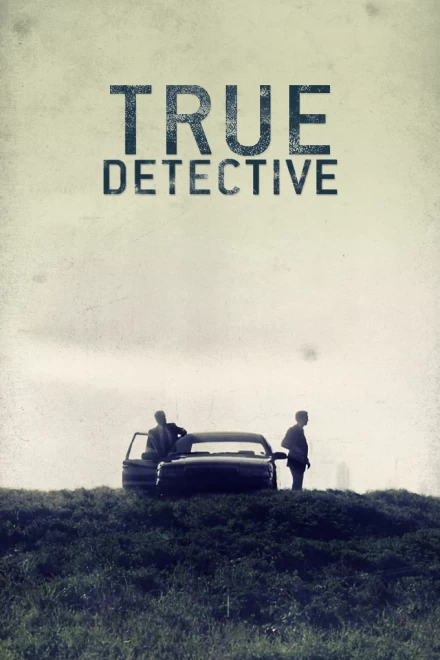
Created by: Nic Pizzolatto
Starring: Matthew McConaughey, Woody Harrelson, Michelle Monaghan
Genres: Crime Drama, Mystery, Psychological Thriller
🌒 Introduction – A Crime Story Beneath a Philosophical Shadow
True Detective Season 1 stands as one of the most influential television achievements of the 2010s. Its structure merges philosophical rumination, nonlinear storytelling, occult mythology, and southern gothic ambience into a narrative that feels both grounded and mythic. The story follows detectives Rust Cohle and Marty Hart as they investigate ritualistic murders in Louisiana. While the case is central, the series uses it as a doorway into deeper questions about identity, trauma, moral decay, and the structures that shape human behavior. The show’s hypnotic atmosphere arises from its interplay between existential dialogue and the slow burn of investigative detail. The season chronicles the breakdown and rebirth of both men, framed through interviews conducted seventeen years after the initial investigation. It becomes a study of memory and myth, revealing how stories evolve through time.
Much of the season’s power comes from its depiction of Louisiana as a symbolic landscape. Swamps, refineries, abandoned churches, and overgrown fields create an environment where modern neglect and ancient superstition coexist. The setting reflects the psychological terrain of the characters. Rust’s bleak worldview and Marty’s compartmentalized morality contrast sharply, yet their partnership forms the unstable backbone of the investigation. Their conflict is not simply procedural but philosophical. The case forces both men to confront aspects of themselves they attempt to keep submerged. The pursuit of the killer becomes a pursuit of internal truth, framed by the haunting idea that the world is shaped by patterns far older and darker than any one life.
🕯️ Act I – The Discovery of Dora Lange
The season opens with the body of Dora Lange, positioned in a ritualistic pose beneath a tree. Crowned with antlers and surrounded by strange symbols, she becomes the entry point into a world of occult imagery. Rust immediately senses the presence of a larger pattern, while Marty approaches the crime with conventional police instincts. Their first exchanges reveal the philosophical divide that will define their relationship. Rust’s monologues about the illusion of self and the tragedy of consciousness stand in contrast to Marty’s preference for predictability and social routine.
As they trace Dora Lange’s movements, they uncover ties to prostitution, drug use, and a revivalist church with unsettling practices. The case expands into a network of vulnerable individuals who fall through society’s cracks. The detectives interview acquaintances who speak of masked figures, strange rituals, and a figure referred to as the Yellow King. These early clues introduce mythological elements derived from Robert W. Chambers’ The King in Yellow, yet the series never fully commits to supernatural explanation. Instead, it uses the mythology to illuminate the psychological architecture of the killers and the systemic failures that enable them.
🔥 Act II – Personal Collapse and the Cost of the Case
As the investigation deepens, the psychological lives of the detectives unravel. Marty’s infidelity fractures his family, exposing his inability to reconcile his public persona with his private impulses. His anger and contradictions become central to his arc, revealing a tension between the order he believes he upholds and the chaos he carries within. Rust, meanwhile, battles the weight of his traumatic past. The death of his daughter and his subsequent collapse into undercover narcotics work haunt him, shaping his worldview into one defined by nihilism. Yet beneath his bleak philosophy lies a moral discipline that drives him to pursue the truth at any cost.
The climax of this act occurs during the violent raid on Ledoux’s compound. The discovery of abused children and hallucinogenic chemicals provides a moment of visceral horror. Marty’s execution of Ledoux and Rust’s orchestration of the scene create a moral fissure between legality and justice. The department quickly wraps the case, framing it as solved. Marty and Rust receive commendations, yet Rust remains unconvinced. His intuition tells him that Ledoux was only a fragment of a far larger and more sinister web.
The tension between truth and institutional convenience becomes one of the season’s recurring themes. Rust’s refusal to accept closure drives him to continue investigating off the books, setting the stage for future conflict. Marty, exhausted by personal turmoil, withdraws into a façade of stability. Their partnership dissolves under the strain. The collapse of their relationship reflects the collapse of the investigation and society’s willingness to ignore uncomfortable realities.
🌩️ Act III – The Reopening of the Past
Seventeen years later, Rust and Marty are called back into the orbit of the case when a new murder echoes the signature of Dora Lange. The nonlinear structure allows viewers to witness the evolution of both men. Rust has become a drifter working in bars, while Marty operates a private security firm. Their interviews with modern detectives frame the narrative, offering layers of perspective and questioning the reliability of memory. The show uses these interviews to highlight how personal histories are constructed. Rust’s sharp intelligence and refusal to conform unsettle the interviewers, who suspect he may be involved in the recent killing.
As new clues surface, Rust uncovers a connection between the killings and powerful figures in Louisiana’s political and religious institutions. Tuttle, a prominent figure associated with religious schools, becomes a focal point of suspicion. Rust discovers photographs and videotapes hinting at systematic abuse and ritualistic actions spanning decades. These revelations suggest a network protected by wealth and influence. The case becomes not just a hunt for an individual killer but an exposure of generational corruption.
When Marty reluctantly rejoins Rust, the two rebuild their fractured partnership. Their reconciliation is one of the season’s emotional anchors. It reflects not sentimentality but a shared recognition that they alone are willing to confront the darkness others avoid. Their renewed investigation leads them closer to the enigmatic figure known as Errol Childress, a man whose deranged mutterings and labyrinthine home reflect a mind shaped by violence, decay, and inherited madness.
🏚️ Carcosa – The Descent into Myth and Madness
The pursuit of Errol Childress culminates in the descent into Carcosa, an overgrown labyrinth of ruined structures and sculpted tunnels. Carcosa serves as the symbolic heart of the series, a place where trauma, myth, and violence intertwine. Though rooted in physical space, Carcosa feels like an extension of the subconscious. Rust experiences visions upon entering, hinting at the porous boundary between trauma and perception. Whether these visions are supernatural or hallucinatory is left ambiguous, reinforcing the series’ commitment to psychological interpretation.
The confrontation with Errol is brutal and intimate. His speech blends fragmented memory with pseudo religious mythology, revealing a lineage of abuse passed down through generations. The series uses Errol not as a mastermind but as a symptom of a larger systemic sickness. His environment, filled with decayed idols and makeshift altars, represents the collapse of meaning within a world shaped by unchecked suffering. Rust’s injury during the fight further symbolizes the cost of seeking truth within structures designed to obscure it.
🌅 Final Episode Analysis – Light in the Darkness
After surviving the battle in Carcosa, Rust delivers a monologue that reframes his nihilism. He speaks of his daughter, of grief, and of the faint presence he felt during near death. The stars above become a metaphor for renewal. Marty remarks that the darkness seems overwhelming, yet Rust counters with a simple insight. If there is only darkness now, then the act of naming the stars becomes an act of resistance. Rust suggests that the history of humanity is the story of light slowly pushing against the dark. This moment softens his earlier fatalism and provides the season with emotional resolution.
The ending does not claim that evil is vanquished or that justice is complete. Instead, it proposes that meaning is found through persistent confrontation with suffering. Rust and Marty’s survival becomes symbolic. They represent flawed individuals who refuse to ignore the darkness, even when institutions do. Their partnership, fractured yet resilient, embodies the idea that truth often emerges through conflict and endurance rather than certainty.
🎯 Final Thoughts – A Masterwork of Psychological Storytelling
True Detective Season 1 remains a landmark in television because it merges crime narrative with philosophical inquiry. Its symbolic architecture, nonlinear structure, and richly textured characters create an experience that feels both literary and cinematic. The season interrogates not only external violence but the internal landscapes that shape human action. It suggests that truth is rarely clean, justice is often incomplete, and identity is a fragile construct that shifts under the weight of memory and trauma.
Through Rust and Marty, the series explores the contradictions at the heart of modern masculinity. Through Carcosa, it examines the legacy of hidden violence. Through its conclusion, it reflects on the possibility of renewal even in a world marked by decay. The result is a story that lingers long after viewing, inviting repeated interpretation. True Detective Season 1 endures because it understands that the most compelling mysteries are not solved, but lived.
 About
About