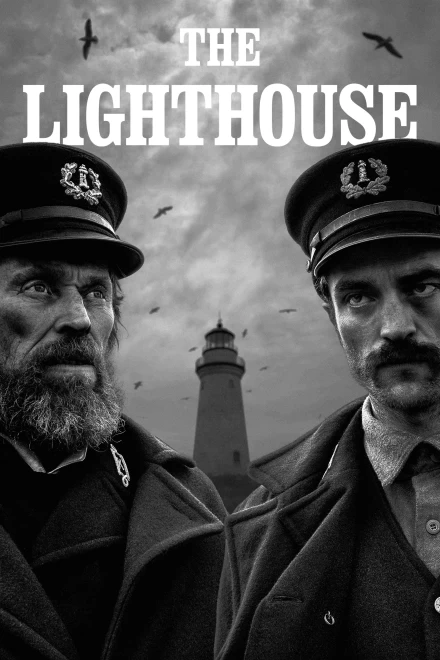
Directed by: Robert Eggers
Starring: Willem Dafoe, Robert Pattinson
Genres: Psychological Horror, Drama
🌊 Introduction – A Descent Into the Mythic Mind
The Lighthouse is not a film that invites passive viewing. It is a confrontation. Directed by Robert Eggers, the film strips narrative down to its most primal elements: two men, an isolated island, and an omnipresent structure that both guides and torments. Rather than telling a conventional story, the film constructs a psychological pressure chamber where identity, power, and sanity erode under relentless isolation. Every frame feels ritualistic, as if the viewer is witnessing an ancient myth re-enacted through modern cinema.
Set in the late nineteenth century, the film follows Ephraim Winslow, a young lighthouse keeper, and Thomas Wake, his domineering superior. Their task appears simple, yet the environment transforms routine labor into existential punishment. The Lighthouse resists literal interpretation. It operates on symbolic logic, where reality fractures and myth intrudes. What unfolds is not merely madness, but a ritualized collapse of self shaped by desire, repression, and power.
🗼 The Lighthouse – Power, Knowledge, and Forbidden Truth
The lighthouse itself is the film’s most dominant symbol. It represents authority, knowledge, and transcendence. Thomas Wake guards the light obsessively, denying Winslow access to it. This imbalance establishes the film’s central power dynamic. The light becomes an object of religious reverence, erotic fixation, and existential longing. It is never shown clearly, reinforcing its status as forbidden truth.
Mythologically, the lighthouse aligns with divine fire. Like Prometheus stealing fire from the gods, Winslow’s desire to reach the light becomes an act of rebellion. The moment he finally ascends and gazes into it, the experience is overwhelming and destructive. Knowledge is not liberating. It is annihilating. The film suggests that some truths are inaccessible without sacrifice, and that the pursuit of transcendence can obliterate the self.
👑 Wake and Winslow – Authority and Rebellion
Thomas Wake embodies tyrannical authority. He dictates routine, controls resources, and enforces submission through language and ritual. His monologues are incantatory, blurring the line between command and curse. Wake’s power is not merely institutional. It is psychological. He defines reality through storytelling, gaslighting Winslow into doubt and dependency.
Winslow represents rebellion born from resentment rather than principle. He resists Wake’s authority but lacks a stable identity of his own. His past is fragmented, marked by guilt and assumed names. This instability makes him vulnerable. The conflict between the two men becomes cyclical, reflecting a power struggle that exists not just externally, but internally within Winslow himself.
🧜 The Mermaid – Desire, Guilt, and Repressed Sexuality
The mermaid symbolizes Winslow’s suppressed desires and unresolved guilt. She appears as both object of pleasure and figure of terror. Her presence collapses the boundary between fantasy and reality, illustrating how repression mutates into obsession. The mermaid is not a literal creature, but a manifestation of Winslow’s fractured psyche.
Her dual nature reflects the film’s treatment of sexuality as both alluring and destructive within a context of isolation and moral rigidity. Winslow’s interactions with the mermaid are followed by shame, reinforcing the cycle of desire and punishment that governs his mental state. The sea itself becomes a womb of unconscious impulses, from which monstrous forms emerge.
🐦 The Seagulls – Guilt and Eternal Punishment
Seagulls recur throughout the film as omens and accusers. Wake claims they contain the souls of dead sailors, transforming them into symbols of guilt and unresolved death. When Winslow kills a seagull in a moment of rage, the act signals his moral rupture. The wind stops, the sea turns hostile, and reality begins to unravel.
This moment marks the collapse of natural order. The killing of the bird is a symbolic violation of taboo, echoing ancient myths where defying sacred law invites divine punishment. From this point onward, Winslow is trapped in a cycle of suffering that feels preordained.
🍶 Alcohol and Ritual – The Erosion of Reality
Alcohol functions as both escape and accelerant. It blurs time, erodes memory, and dissolves boundaries between the men. Their drinking sessions resemble ritualistic ceremonies, where confessions, curses, and power reversals occur. Language itself becomes unstable, shifting from mundane dialogue to Shakespearean invective.
Through intoxication, the film dismantles linear narrative. Days collapse into one another. Past and present become indistinguishable. This temporal confusion reinforces the idea that the island exists outside ordinary reality. It is a liminal space where identity is stripped away.
🧠 Madness or Myth – What Is Really Happening?
The Lighthouse deliberately refuses to clarify whether events are supernatural or psychological. This ambiguity is central to its meaning. The film operates as both myth and mental breakdown. Wake may be a godlike figure, or he may be an ordinary man exploiting power. The light may be divine truth, or it may be the final hallucination of a collapsing mind.
By denying certainty, the film forces viewers to confront how meaning is constructed. Madness becomes indistinguishable from revelation. Isolation reveals not truth, but the fragility of perception itself.
🔥 The Ending – Eternal Punishment and the Price of Knowledge
The final image of Winslow lying naked on the rocks as seagulls consume his organs directly mirrors the myth of Prometheus. Having stolen forbidden knowledge, he is condemned to endless punishment. Whether this scene is literal or symbolic is irrelevant. It represents the ultimate cost of transgression.
Winslow achieves what he desires, but the achievement annihilates him. The film closes not with resolution, but with mythic inevitability. Knowledge, power, and transcendence are inseparable from suffering.
🎯 Final Thoughts – A Modern Myth of Isolation
The Lighthouse functions as a cinematic myth, using horror to explore deeply human anxieties. It examines masculinity as a performance shaped by power, repression, and fear of insignificance. Isolation does not reveal authenticity. It magnifies instability.
Robert Eggers crafts a film where symbols replace answers and ambiguity becomes meaning itself. The Lighthouse endures because it refuses interpretation as conquest. Instead, it demands surrender. Like the light at its center, it promises revelation, but delivers dissolution.
 About
About