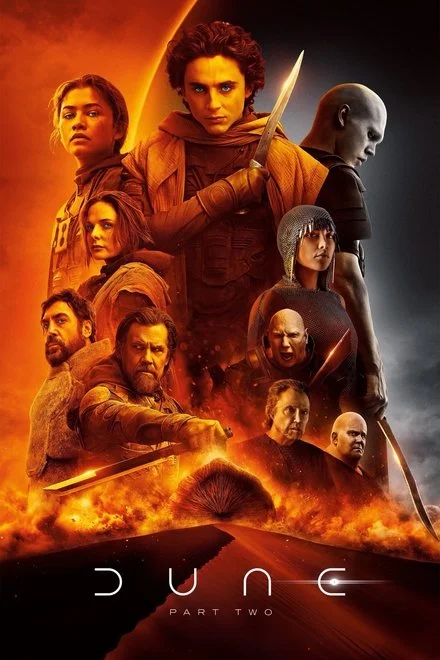
Directed by: Denis Villeneuve
Starring: Timothée Chalamet, Zendaya, Austin Butler, Florence Pugh, Josh Brolin, Rebecca Ferguson
🏜️ Introduction — From Exile to Reckoning
Denis Villeneuve’s Dune: Part Two continues the epic saga of House Atreides, following Paul’s transformation from fugitive to messianic leader. Expanding upon Frank Herbert’s original novel, the film plunges deeper into the themes of destiny, faith, ecology, and the peril of power. Part Two merges intimate character drama with vast interstellar warfare, delivering both spectacle and existential weight.
🧩 Act I — Paul Among the Fremen: Training, Vision, and Alliance
The film opens in the desert wilderness of Arrakis, where Paul (Timothée Chalamet) and his mother, Lady Jessica (Rebecca Ferguson), have found refuge among the Fremen after the destruction of House Atreides. The narrative picks up immediately after the events of Part One, grounding us in the harsh rhythms of Fremen life — survival, secrecy, and spiritual devotion.
Paul trains under Stilgar and begins to integrate into the tribe. His relationship with Chani (Zendaya) evolves from trust to love, offering him both strength and conflict. The Fremen whisper about him as the “Lisan al-Gaib,” the long-prophesied messiah who will lead them to freedom. Yet Paul is plagued by visions of futures soaked in blood — holy wars fought in his name, across countless worlds. Villeneuve frames these prophetic sequences as both beautiful and terrifying, portraying the burden of foresight as a psychological cage.
Jessica, meanwhile, embraces the Bene Gesserit path, drinking the Water of Life and becoming the Fremen’s new Reverend Mother. Her transformation connects her telepathically with her unborn daughter, Alia, who will one day become a pivotal figure in the Dune mythos. These moments are mystical, eerie, and filled with foreboding.
⚔️ Act II — War on Arrakis: Strategy, Sacrifice, and Fury
Paul grows into a warrior and strategist, leading daring ambushes against Harkonnen spice harvesters. The desert warfare scenes are both ferocious and poetic — sandworms rise beneath armored convoys, explosions light up the endless dunes, and the Fremen’s guerrilla tactics begin to cripple the Harkonnen grip on the planet.
Throughout this act, Paul’s legend spreads. Stilgar’s faith in him strengthens, while Chani remains wary of the myth overtaking the man she loves. She fears the prophecy more than the enemy — a recurring tension that humanizes the film’s spiritual overtones. The line between liberation and fanaticism begins to blur.
Back on Giedi Prime, the Harkonnen homeworld, we meet Feyd-Rautha (Austin Butler), the sadistic heir to the Harkonnen dynasty. His introduction is unforgettable: a gladiatorial combat sequence drenched in monochrome lighting and madness. Feyd is as charismatic as he is monstrous — the perfect foil to Paul’s reluctant heroism.
💥 Act III — The Confrontation: Betrayal and Ascension
Paul’s rise culminates in open war. After uniting the southern and northern Fremen tribes, he becomes both their military commander and spiritual figurehead. Jessica guides him deeper into Bene Gesserit knowledge, but her manipulative tendencies create friction. Paul’s internal conflict reaches its peak when he drinks the Water of Life — a ritual forbidden to men. The sequence is hallucinatory and cosmic, showing him visions of galaxies, atomic fire, and his future as both savior and destroyer.
Having survived the ordeal, Paul gains prophetic clarity and declares himself the Kwisatz Haderach — the super-being long prophesied by the Bene Gesserit. With renewed vision, he rallies the Fremen for the ultimate siege against the Harkonnens and the Emperor’s Sardaukar legions, who have arrived to crush the rebellion once and for all.
The final battle is awe-inspiring. Sandworms thunder through the desert as Paul and the Fremen overwhelm the imperial army. Villeneuve contrasts the grandeur of the battle with the intimacy of its cost — we see Chani fighting beside Paul, Stilgar wounded but unbroken, and the sands turning crimson under the twin suns.
👑 The Throne Room: Triumph and Tragedy
After the victory, Paul confronts Emperor Shaddam IV (Christopher Walken) inside a massive stone citadel. He demands recognition of his rule and the Emperor’s abdication. In a dramatic duel, Paul kills Feyd-Rautha, avenging his family and sealing his dominance.
The Emperor’s daughter, Princess Irulan (Florence Pugh), watches in silence as Paul proposes marriage to secure political peace. She accepts, aware that their union is strategic, not romantic. Chani’s face hardens as she realizes what Paul has become — not the man she loved, but the legend others demanded. Her final departure across the desert is devastating: a silent refusal to follow him into empire.
Paul’s ascent to power is total. Yet as the Fremen chant his name, the camera lingers on his haunted expression. He has achieved everything, and in doing so, unleashed the nightmare of his visions — an unstoppable jihad spreading in his name.
🔍 Ending Explained — The Messiah and the Monster
The ending of Dune: Part Two is a paradox. Paul wins every battle but loses his soul. His transformation from idealistic heir to godlike ruler mirrors the central warning of Herbert’s novel: that power and faith, when fused, can birth tyranny. Paul’s prescience lets him foresee the destruction caused by his own followers, yet he cannot prevent it. His destiny consumes him as surely as the desert consumes the fallen.
Villeneuve leaves us with an image of Paul staring across the dunes, his eyes reflecting both triumph and dread. The sound of distant chanting grows into a roar — an echo of the holy war to come. The prophecy is fulfilled, but its fulfillment is the beginning of humanity’s greatest tragedy.
🎭 Themes and Symbolism
- Prophecy and Free Will: Paul’s visions illustrate that knowing the future does not grant the power to change it. His attempts to resist fate only bring it closer.
- Religion as Weapon: The Bene Gesserit’s myth-making turns faith into manipulation, showing how belief can shape — and destroy — civilizations.
- Love and Duty: Chani represents human connection and truth, while Irulan represents political necessity. Paul’s choice between them marks the death of his innocence.
- Ecology and Empire: Arrakis’s sand and spice remain symbols of control — whoever owns the desert controls the universe. Yet, the planet itself resists domination.
📊 Reception and Legacy
Upon release, Dune: Part Two was hailed as one of the most ambitious science fiction films ever made. Critics praised its visual grandeur, Hans Zimmer’s transcendent score, and the performances of Chalamet, Zendaya, and Butler. The film dominated the box office, surpassing expectations and solidifying Villeneuve’s adaptation as a landmark in modern cinema.
Audiences admired its balance between philosophical reflection and large-scale storytelling. Some viewers found its pacing demanding, but most agreed that the payoff — emotional, visual, and intellectual — was immense. The film concludes with open threads that set up Dune Messiah, Villeneuve’s planned third entry, promising an even darker evolution of Paul’s myth.
🎯 Final Thoughts — The Fire That Consumes
Dune: Part Two transforms the traditional hero’s journey into a meditation on destiny and destruction. Paul Atreides becomes both savior and oppressor, illustrating the danger of absolute belief in any one person or prophecy. Denis Villeneuve’s vision fuses mythic grandeur with human fragility, making every triumph feel like a prelude to downfall.
By the end, the sands of Arrakis swallow both heroes and empires alike, leaving behind only the whisper of prophecy and the rhythm of the desert wind — eternal, impartial, and haunting. The story of Paul Atreides is far from over; it has merely entered its most perilous phase.
📚 Selected Sources & Further Reading
Key references for this explainer include the official Dune: Part Two production notes, Denis Villeneuve interviews, and critical reviews from RogerEbert.com and The Guardian. For readers seeking deeper context, Frank Herbert’s original Dune novel and Dune Messiah provide essential background on Paul’s arc and the moral paradoxes that define his legacy.
 About
About