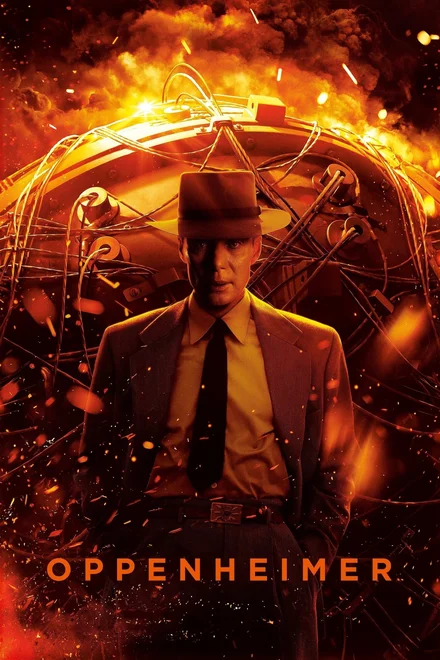
Directed by: Christopher Nolan
Starring: Cillian Murphy, Robert Downey Jr., Emily Blunt, Matt Damon, Florence Pugh
💣 Introduction: The Man Who Saw the Future
Christopher Nolan’s Oppenheimer (2023) is not simply a biopic — it’s a philosophical and psychological exploration of genius, guilt, and the moral cost of creation. Adapted from the Pulitzer Prize–winning biography American Prometheus, the film chronicles the life of theoretical physicist J. Robert Oppenheimer (Cillian Murphy), the father of the atomic bomb. Structured across multiple timelines, Nolan presents both the myth and the man: a visionary haunted by the consequences of his own intellect.
The film’s narrative is a complex interplay between memory, politics, and perception. Told in both color and black-and-white — each representing subjective and objective perspectives — it dissects the man who made the weapon that changed the world forever. Through its dense dialogue, stark editing, and thunderous sound design, Oppenheimer becomes an experience as much as a story — a portrait of brilliance entangled in existential dread.
🧠 Act I: The Mind of Fire
The film opens with Oppenheimer as a young physicist at Cambridge University in the 1920s. Plagued by anxiety and insomnia, he experiences the world through an abstract lens — waves of atoms, collapsing stars, the hum of energy invisible to others. His intellect is matched only by his emotional fragility. During an early crisis, he nearly poisons his mentor, a reflection of his volatile genius and inner chaos.
Soon after, Oppenheimer travels to Germany to study quantum mechanics under the pioneers of the new atomic age. Here, he meets Niels Bohr, Werner Heisenberg, and other titans of physics, absorbing ideas that will define his life. His fascination with energy and entropy becomes a metaphor for his own psychological state — a man constantly balancing creation and destruction within himself.
Returning to the U.S., he begins teaching at Berkeley, becoming a magnet for bright minds and revolutionary thought. He is charismatic yet distant, loved yet feared, a man driven by the thrill of discovery but unable to grasp human connection fully. His romantic entanglements — particularly with Jean Tatlock (Florence Pugh), a passionate but troubled communist — reveal his longing for something spiritual, something that science alone cannot explain.
⚛️ Act II: The Manhattan Project
As World War II escalates, General Leslie Groves (Matt Damon) recruits Oppenheimer to lead the top-secret Manhattan Project — the U.S. government’s race to build an atomic bomb before Nazi Germany. The physicist is an unlikely choice: left-leaning, controversial, and morally conflicted. Yet Groves sees his brilliance and charisma as essential for uniting the disparate scientists under one vision.
Oppenheimer accepts, partly out of patriotism and partly out of fear. He assembles a team of the world’s greatest minds in the remote desert of Los Alamos, New Mexico. The creation of this scientific utopia — equal parts laboratory and fortress — becomes the film’s centerpiece. Every detail is soaked in paradox: scientific triumph fused with moral decay, friendship shadowed by secrecy, and progress undercut by paranoia.
Nolan masterfully contrasts the serene landscape of Los Alamos with the infernal work taking place inside. The film pulsates with energy — equations scribbled across blackboards, flashes of atomic light, and fragments of haunting imagery that foreshadow the devastation to come. Amidst the camaraderie and intellectual fervor, a sense of doom builds, intensified by Ludwig Göransson’s seismic score.
🔥 The Trinity Test: “Now I Am Become Death”
The emotional and narrative apex arrives with the Trinity Test — the first detonation of an atomic bomb on July 16, 1945. Nolan captures the scene with excruciating tension: silence stretching to the breaking point, faces bathed in ghostly orange, and then an explosion so enormous that it seems to tear open reality itself.
The sound drops out completely — replaced by a horrifying silence that makes the moment almost spiritual. As the light fades, Oppenheimer whispers the now-immortal words from the Bhagavad Gita: “Now I am become Death, the destroyer of worlds.” It’s a triumph that immediately curdles into horror.
Back at Los Alamos, celebrations erupt. The scientists cheer, yet Oppenheimer’s eyes are hollow. He sees not victory but annihilation. His face becomes a canvas of guilt as the world around him descends into patriotic fervor. In a harrowing sequence, he imagines a crowd disintegrating under atomic light — a hallucinatory montage that conveys the moral implosion of the man who made apocalypse possible.
⚖️ Act III: Fallout — The Political Trial
The narrative shifts to the 1950s, when Oppenheimer’s past affiliations and moral hesitation turn against him. The color sequences represent his perspective; the stark black-and-white ones depict the bureaucratic machinery dismantling him. Lewis Strauss (Robert Downey Jr.), a powerful politician and head of the Atomic Energy Commission, begins a covert campaign to destroy Oppenheimer’s reputation.
In the wake of the Cold War, Oppenheimer becomes a liability — a man who questions the government’s pursuit of ever-deadlier weapons. His opposition to the hydrogen bomb and his former ties to communists give his enemies the ammunition they need. A closed-door security hearing strips him of his clearance, symbolically erasing his legacy.
Nolan stages the interrogation scenes like psychological warfare — fluorescent-lit, suffocating, and filled with venomous cross-examination. The very government that celebrated him now devours him, transforming the “father of the bomb” into a pariah. His wife Kitty (Emily Blunt) delivers a searing defense, yet it’s futile. The same intellect that changed history cannot save itself from politics.
🧩 Act IV: Strauss, Power, and Retribution
Parallel to Oppenheimer’s downfall runs Strauss’s Senate confirmation hearing, a cold, procedural mirror of Oppenheimer’s emotional trial. Robert Downey Jr. delivers a restrained yet ferocious performance as a man consumed by envy — his personal resentment masquerading as patriotism. Through these dual timelines, Nolan shows how personal vendettas and political paranoia rewrite history itself.
As the film weaves between these hearings, flashbacks reveal Strauss’s manipulations: misquoting Oppenheimer, framing him as arrogant and untrustworthy, feeding the press lies. Yet justice arrives in a quiet form — a Senate aide (played by Alden Ehrenreich) sees through the deceit, questioning Strauss’s motives and ultimately derailing his confirmation.
In a chilling moment, Strauss realizes he will be remembered not as a statesman but as the man who tried to destroy Oppenheimer. Nolan doesn’t let this victory feel triumphant — it’s bitter, hollow, and fleeting.
☢️ The Ending Explained: The Fire That Never Ends
In the film’s haunting final scene, an older Oppenheimer meets Albert Einstein (Tom Conti) by the pond outside Princeton — a conversation glimpsed throughout the film but never fully heard until now. Einstein, once a father figure to Oppenheimer, warns him that the path of scientific progress is a chain reaction that cannot be undone.
Oppenheimer recalls the moment he once feared — that the bomb might ignite the atmosphere and destroy the world. Now, in hindsight, he realizes: it already did. Not in fire, but in spirit. Humanity crossed a moral threshold, and the chain reaction has never stopped.
As the screen fills with the reflection of fire consuming the Earth, Nolan closes on Oppenheimer’s hollow eyes. The final line — “I believe we did” — encapsulates the film’s theme: knowledge as both illumination and damnation. The explosion that once symbolized power now burns eternally in the conscience of its creator.
🎭 Themes and Symbolism
- Duality of Creation and Destruction: Science as both salvation and damnation. Oppenheimer’s brilliance births horror, echoing Prometheus’s theft of fire.
- Subjectivity of Truth: Nolan’s dual color palette reflects two realities — memory (color) versus political “fact” (black and white).
- Isolation of Genius: Oppenheimer’s loneliness mirrors that of the very universe he studies — vast, cold, and indifferent.
- Guilt and Legacy: The film’s cyclical structure emphasizes the inescapable weight of conscience — a mind forever replaying the explosion it caused.
📉 Reception and Legacy
Oppenheimer became one of the most critically acclaimed films of the decade. It grossed over $950 million worldwide, earning 13 Oscar nominations and winning 7, including Best Picture, Best Director, and Best Actor for Cillian Murphy. Critics praised its ambition, sound design, and performances, while some noted its emotional detachment and density.
Ultimately, the film stands as Christopher Nolan’s magnum opus — a work of staggering intellect and haunting emotional gravity. It captures the paradox of genius: the power to change the world, and the inability to live with what that change brings.
Through fire, silence, and conscience, Oppenheimer reminds us that the greatest explosions are not heard in deserts — but inside the human soul.
 About
About