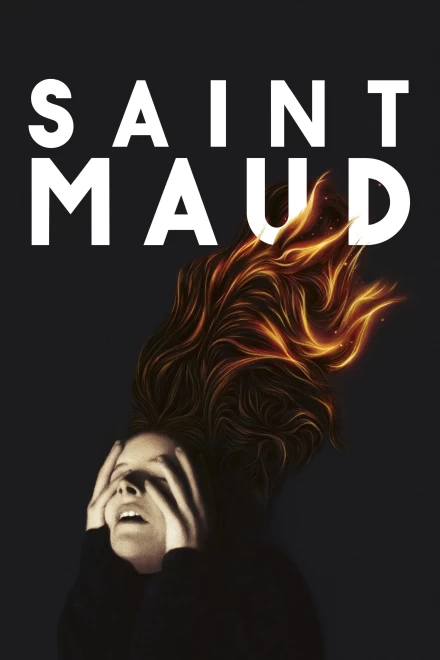
Written and Directed by: Rose Glass
Starring: Morfydd Clark, Jennifer Ehle
Genres: Psychological Thriller, Horror, Drama
🕯️ Introduction – Faith at the Edge of the Mind
Saint Maud is a film about devotion stripped of community, ritual, and balance. It presents faith not as a shared belief system, but as a solitary obsession formed in isolation and sustained through delusion. Rather than depicting religion as inherently destructive, the film examines what happens when belief becomes a substitute for identity. Maud does not merely believe in God. She needs God to give her existence meaning.
Set almost entirely within confined interiors, the film follows Maud, a live-in hospice nurse who becomes convinced that she has been chosen to save the soul of her terminally ill patient, Amanda. As Maud’s sense of purpose intensifies, so does her detachment from reality. The film operates almost entirely within Maud’s subjective experience, forcing the audience to inhabit her psychological deterioration. What unfolds is not a supernatural possession, but a portrait of untreated mental illness filtered through religious imagery.
🧠 Maud – Identity Built on Guilt
Maud’s transformation into a religious zealot is rooted in trauma. Before adopting her new identity, she was Katie, a nurse involved in an unexplained incident that resulted in a patient’s death. Though details are sparse, the emotional impact is unmistakable. Guilt becomes the core around which her new self is constructed.
By renaming herself Maud, she symbolically erases her former identity. Faith becomes a means of purification. Her devotion offers structure, certainty, and moral hierarchy. Without it, Maud would be forced to confront her own responsibility and ambiguity. Instead, she reframes suffering as divine purpose and guilt as spiritual trial. This reframing allows her to endure loneliness while convincing herself that isolation is proof of chosenness.
The film portrays Maud not as evil, but as profoundly vulnerable. Her beliefs fill the void left by human disconnection. She prays not out of joy, but desperation.
🏠 Isolation as Psychological Pressure
Saint Maud emphasizes isolation as a catalyst rather than a symptom. Maud lives alone in a sparse apartment. Her interactions are minimal, transactional, and emotionally distant. The town itself feels cold and indifferent. Even casual social encounters end in discomfort or rejection.
This absence of meaningful connection intensifies Maud’s internal world. With no external voices to challenge her beliefs, her inner monologue grows louder and more authoritative. The film’s sound design reinforces this dynamic. Moments of silence are heavy, broken only by Maud’s whispered prayers or imagined divine responses.
Isolation removes friction. Without contradiction, belief hardens into certainty. Saint Maud presents loneliness not as sadness, but as a breeding ground for absolutism.
🛏️ Amanda – The Threat of Complexity
Amanda, Maud’s patient, represents everything Maud fears. She is openly atheist, sexually confident, sarcastic, and unrepentant. Where Maud seeks purity, Amanda embraces ambiguity. Her refusal to submit to Maud’s worldview destabilizes Maud’s sense of mission.
Amanda is not portrayed as cruel, but she is deliberately provocative. She exposes the fragility of Maud’s beliefs by refusing redemption. To Maud, this resistance is not personal. It is cosmic. If Amanda cannot be saved, then Maud’s purpose collapses.
Their relationship becomes a power struggle disguised as care. Maud’s concern shifts from compassion to control. Saving Amanda’s soul becomes more important than respecting her autonomy. This shift marks the point where faith transforms into coercion.
🔥 Religious Ecstasy or Hallucination?
Throughout the film, Maud experiences moments she interprets as divine communion. Her body convulses. Her voice changes. She feels physically lifted by presence she believes is God. The film never confirms these experiences as supernatural. Instead, they are framed ambiguously, grounded in physical sensation and emotional intensity.
These episodes resemble documented religious psychosis, where intense belief produces sensory hallucinations. The film does not ridicule these experiences. It presents them with restraint, allowing the audience to understand how convincing they feel to Maud. The terror lies in how authentic delusion can feel from within.
By aligning the camera with Maud’s perspective, Saint Maud forces viewers to question the reliability of perception itself. Faith becomes indistinguishable from pathology when belief replaces reality testing.
🔪 The Breaking Point – When Salvation Becomes Violence
Maud’s final act toward Amanda is framed as mercy within her belief system. Convinced that Amanda’s suffering is eternal, Maud interprets killing her as an act of salvation. This moment crystallizes the film’s central warning. When belief overrides empathy, violence becomes justifiable.
The scene is deliberately stripped of spectacle. There is no triumph, only confusion and terror. Amanda’s final words shatter Maud’s certainty. In death, Amanda does not validate Maud’s faith. She denies it. This denial destabilizes Maud completely.
For the first time, Maud’s belief fails to provide meaning. The voice she trusted falls silent.
🔥 Ending Explained – One Second of Truth
In the film’s final sequence, Maud walks into public space believing herself to be a saint. She imagines herself crowned in divine light, embraced by a watching crowd. For a brief moment, the audience shares her vision. The fantasy is radiant and affirming.
Then the film cuts to reality for a single, devastating second. Maud is screaming in agony as she burns herself alive. There is no divine presence. No transcendence. Only pain.
This final cut is the film’s most important statement. Saint Maud does not argue that faith is false. It argues that delusion is deadly when mistaken for revelation. The abrupt return to reality exposes the cost of unchallenged belief. Maud’s entire spiritual narrative collapses in that instant.
🧩 What Saint Maud Is Really About
Saint Maud is a psychological study of how meaning is constructed under emotional duress. It examines how guilt, isolation, and longing can reshape belief into something rigid and destructive. The film is not anti-religious. It is anti-absolutism.
Maud’s tragedy lies not in her faith, but in her solitude. Had her beliefs been held within a community, challenged, tempered, or shared, they might not have consumed her. Instead, faith becomes a closed loop, reinforcing itself until reality can no longer intrude.
🎯 Final Thoughts – A Quiet, Devastating Psychological Portrait
Saint Maud lingers because it offers no villains, only consequences. It refuses to externalize evil. The horror comes from recognition. Maud’s need for meaning, forgiveness, and connection is profoundly human.
By ending on truth rather than transcendence, the film delivers one of the most brutal final moments in modern psychological cinema. It reminds us that belief without grounding can become a weapon against the self. Saint Maud is not about possession. It is about what happens when the mind, desperate for purpose, builds a god in its own image.
 About
About