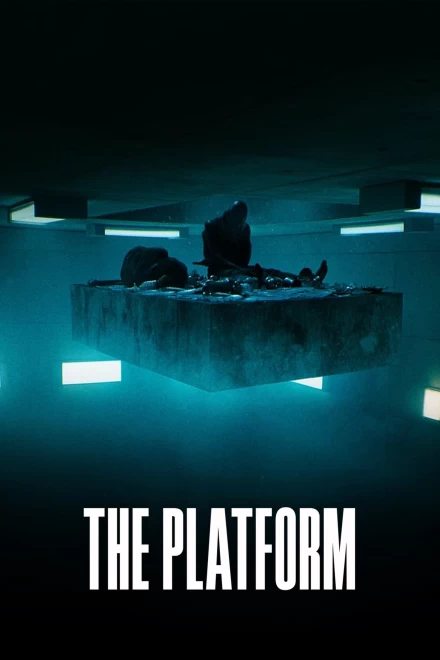
Directed by: Galder Gaztelu Urrutia
Starring: Iván Massagué, Zorion Eguileor, Antonia San Juan
🕳️ Introduction to a Brutal Social Experiment
The Platform is one of the most unsettling and philosophically dense films released in the past decade. Rather than relying on conventional horror tropes, it constructs a controlled environment where hunger, hierarchy, and human desperation collide. The setting, a vertical prison known as the Vertical Administration Center, is a structure designed to reveal how individuals respond to deprivation and abundance. Every day, a platform laden with food descends through the tower, allowing each level to eat only what remains from the levels above. The film uses this system as a metaphor for inequality, resource distribution, and human behavior under pressure.
Goreng, the protagonist, enters voluntarily, believing he will receive certification after completing six months. His naïve hopes contrast sharply with the cynicism of other inmates. From his introduction to the institution, the narrative establishes a philosophical tension between ideals and survival. The Platform does not present its world as a simple critique of capitalism or class structure. Instead, it asks viewers to examine how structures of inequality are internalized. The tower becomes a model of society stripped to its essentials, exposing the instinctual and ideological impulses that guide human choices.
🍽️ Act I – Understanding the Vertical Prison
The early section of the film traces Goreng’s initial attempt to understand the rules of the system. His cellmate Trimagasi has adapted completely to the tower’s logic. He speaks in circular anecdotes, expressing a fatalistic worldview shaped by his time inside. For him, the platform is a neutral mechanism. The real variable is human choice. If people on the upper floors behave selfishly, those below inevitably suffer. The design of the tower encourages division and resentment, since each level can see only the remains of previous consumption.
Food, which should be a universal necessity, becomes a symbol of power. As the platform descends, its offerings deteriorate into scraps. The disparity between levels reinforces a kind of vertical caste system, determined entirely by chance. The randomness of level assignments reveals the arbitrariness of privilege. Position in the tower does not reflect merit or morality, yet it dictates survival. The film pushes viewers to consider how much of our world follows similar logic, where birth or structural advantage determines access to resources.
During these early scenes, the film subtly outlines how identity erodes under conditions of scarcity. Goreng enters with books, ideals, and cultured sensibilities, but the tower steadily compresses his perception of what matters. Trimagasi’s pragmatic cruelty appears repugnant, yet the film suggests that ideological purity is difficult to maintain when starvation becomes a daily threat.
🩸 Act II – Chaos, Violence, and the Search for Order
As the narrative progresses, the tower becomes a battlefield for survival. When Goreng awakens on a much lower floor, the theoretical understanding of inequality becomes personal. Hunger strips away intellectual detachment. This transition marks one of the film’s most important thematic turns, illustrating how systemic injustice is often invisible until experienced directly. Goreng’s struggle reveals that moral judgment becomes far more complicated when one is placed in a position of deprivation.
Miharu, an enigmatic figure who rides the platform searching for her child, disrupts the tower’s mechanical routine. Her presence introduces ambiguity into the system’s order. She acts violently and unpredictably, yet she embodies a kind of emotional resistance. Miharu is driven by maternal devotion in a structure designed to remove personal connection. Her existence challenges the assumption that the tower is perfectly controlled. She represents the possibility of individual agency within an oppressive system.
The arrival of Imoguiri, a former administrator of the tower, broadens the philosophical scope. Her belief in rationing and moral persuasion contrasts sharply with Trimagasi’s fatalism. She insists that cooperation is possible if people choose restraint. Yet the tower responds to her idealism with indifference. Her belief that rational instruction can overcome desperation proves fragile. The film suggests that moral appeals alone cannot correct a system built to incentivize selfishness. Imoguiri’s death marks the collapse of institutional idealism, leaving Goreng alone to navigate the psychological ruins.
⚔️ Act III – The Descent with Baharat
The third act begins when Goreng partners with Baharat, a man who believes he can climb to the top. His rope symbolizes hope, ambition, and upward mobility. When people on higher floors reject and humiliate him, the film makes a pointed comment about how those with privilege often dismiss those attempting to rise. The violence he faces for simply trying to ascend reinforces the rigidity of hierarchical systems.
Goreng persuades Baharat that real change lies not in climbing upward, but in descending with the platform to ensure equitable distribution of food. This marks the film’s shift from individual survival to collective responsibility. Their journey downward becomes a moral pilgrimage. They defend the platform against those who would hoard or destroy food, becoming enforcers of an improvised ethic. Their use of violence to enforce fairness raises uncomfortable questions about whether justice can exist without coercion. The film acknowledges that social reform often requires confrontation with entrenched behavior, and that such struggle is rarely peaceful.
As they descend, the conditions worsen dramatically. The lower levels reveal scenes of despair and cruelty that exceed even Goreng’s earlier expectations. The journey becomes not just physical but psychological, forcing both men to confront the limits of empathy. Baharat’s faith, initially vibrant, begins to fracture under the weight of suffering. The farther they travel, the more the tower resembles a descent into the collective subconscious of society.
🎒 The Panna Cotta, the Child, and the Meaning of Hope
The panna cotta, introduced as a symbolic message, represents the belief that a small act of preservation can disrupt the system. Imoguiri believed that returning a perfectly intact dish to the administrators would signal the need for reform. Goreng initially adopts this plan as a practical gesture of resistance. Yet when he and Baharat encounter the child on the lowest level, the film shifts its symbolic anchor. The child becomes the new message, superseding material symbolism with human presence.
The discovery of the child challenges the foundational assumptions of the system. The administrators insisted that children were forbidden, yet the child is alive, defying institutional rules. This revelation destabilizes the notion of total control within the tower. The child represents innocence, possibility, and the future, qualities absent from the structure’s design. She is a living contradiction that the system cannot account for.
When Baharat dies from his injuries, Goreng is left alone to decide the meaning of the message. He concludes that the child must be sent upward as a symbol of truth and moral contradiction. The panna cotta was a gesture, but the child is a confrontation. Her ascent is meant to force the administrators to acknowledge the flaws of their system. Whether this acknowledgment will lead to change remains uncertain.
🔚 Ending Explained – What Really Happens?
In the final moments, the platform begins to rise with the child on it. Goreng chooses not to accompany her, recognizing that his own presence would distort the message. He walks into the darkness with the vision of Trimagasi, suggesting a merging of memory, guilt, and resignation. This final scene has multiple interpretations, each supported by the film’s layered structure.
One interpretation views the ascent as literal. The child physically travels upward, becoming a catalyst for reform. Yet the film offers no explicit confirmation that the administrators will react meaningfully. Another interpretation sees the scene as symbolic, implying that the child represents an idea rather than a physical being. Goreng’s hallucinations and deteriorating mental state open the possibility that the child is a metaphor for hope, compassion, or the human capacity for renewal.
A darker interpretation suggests that no reform is possible within systems designed around hierarchy and scarcity. The message may never be understood, and the cycle of suffering will continue. The film intentionally avoids offering clarity. Instead, it leaves viewers in a state of reflective uncertainty, mirroring the ambiguity of real-world attempts at social reform. Its refusal to provide closure reinforces the idea that systemic change rarely follows a straightforward path.
The ending forces viewers to confront whether symbolic gestures are enough to challenge deeply ingrained structures of inequality. Goreng’s sacrifice embodies the belief that meaning can emerge even in oppressive systems, but the film stops short of confirming that his belief will lead to transformation.
🎯 Final Thoughts – A Brutal Mirror of Society
The Platform is designed as an allegory rather than a puzzle. Its purpose is not to provide answers, but to provoke confrontation with uncomfortable truths about consumption, privilege, and human nature. The vertical structure visualizes the fragility of social cohesion. Cooperation breaks down when survival is threatened, yet the possibility of empathy remains present, however strained. Goreng’s journey captures the painful negotiation between self-interest and moral responsibility.
The film’s enduring impact lies in its refusal to simplify. Every character embodies a different philosophical stance, from fatalism to idealism to righteous violence. The Platform suggests that systems of inequality persist not because people are inherently cruel, but because structures themselves encourage competition. Yet within these structures, individuals retain the capacity for choice, sacrifice, and hope. By the end, the film leaves us with a haunting question: Can a message, even one carried by innocence itself, disrupt a system that benefits from silence?
 About
About