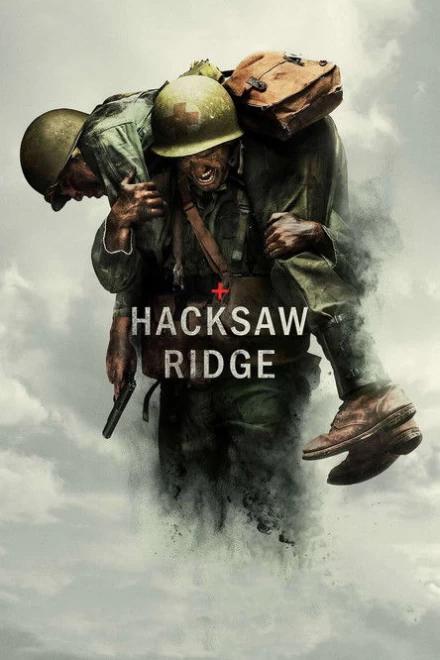
Directed by: Mel Gibson
Starring: Andrew Garfield, Sam Worthington, Teresa Palmer, Vince Vaughn, Luke Bracey
Genres: War Drama, Biography, True Story
🌄 Introduction – A War Story About Conviction
Hacksaw Ridge recounts the remarkable true story of Desmond Doss, a combat medic who served in World War II without ever touching a weapon. His refusal to carry a rifle stemmed from deeply held religious convictions and childhood trauma. Yet he volunteered for service, determined to contribute to the war effort in a way aligned with his conscience. The film traces his journey from a quiet life in Virginia to the brutal heights of the Battle of Okinawa, where his courage and perseverance earned him the Medal of Honor. What makes the film extraordinary is not only the historical events it describes but the way it presents conviction as a force capable of transforming both individuals and institutions.
At its core, Hacksaw Ridge explores the intersection between faith and violence, asking how a single person can remain morally anchored in an environment built on destruction. Doss does not reject the war itself. Instead, he refuses to compromise the values he believes define his humanity. His story challenges traditional notions of masculinity and heroism, demonstrating that courage can take forms not typically associated with combat. This contrast between personal conviction and military expectation becomes the driving tension of the narrative.
🏠 Act I – Childhood, Trauma, and Identity Formation
The film opens with Doss’s upbringing in rural Virginia. His father, Tom Doss, is a World War I veteran haunted by trauma and grief. The emotional scars he carries shape the family’s atmosphere, creating cycles of alcohol use and anger. Doss’s early exposure to violence within the home profoundly influences his moral development. A childhood fight with his brother nearly turns fatal when Desmond strikes him with a brick. This moment becomes a turning point. Realizing the destructive potential within himself, Desmond internalizes a commitment to nonviolence.
His religious faith, nurtured within the Seventh day Adventist tradition, becomes the framework through which he understands this commitment. The film emphasizes how Desmond’s convictions arise not from abstract doctrine but from lived experience. His moral code emerges from fear, reflection, empathy, and a deep desire to protect others. These early experiences provide the psychological foundation for the man he becomes, illustrating how personal history can shape ethical identity long before it is tested by external circumstances.
❤️ Act II – Meeting Dorothy and Enlisting in the Army
Before entering the war, Doss meets Dorothy Schutte, a nurse whose kindness and steadiness provide emotional stability in his life. Their bond is gentle and sincere, presenting a counterpoint to the violence that will later dominate the narrative. Dorothy supports Desmond’s decision to enlist, though she does not fully grasp the challenges he will soon face. Her presence represents the life he hopes to return to, grounding him amid the chaos of training and battle.
Desmond’s decision to enlist is driven by a sense of duty rather than aggression. He believes that serving as a medic aligns with his moral values. His aim is to save lives, not take them. This nuanced position highlights the complexity of patriotism and ethical responsibility. Desmond’s enlistment challenges the assumption that participation in war requires uniformity of belief. Instead, the film illustrates that individuals bring diverse motivations and moral frameworks to the battlefield.
⚔️ Act III – Training, Resistance, and the Fight for Conscience
The training sequences introduce significant conflict between Desmond and his fellow soldiers. His refusal to handle a rifle leads others to view him as a liability. Sergeant Howell and Captain Glover, frustrated by what they perceive as insubordination, pressure Doss to comply with standard procedure. The group ostracizes him, doubting that a man who will not carry a weapon belongs in combat. The hostility escalates into harassment and physical confrontation.
Desmond’s insistence on remaining in the unit without compromising his beliefs transforms the conflict into a broader ideological struggle. His fight becomes one of recognition, as he demands the right to serve on his own ethical terms. When the military attempts to court martial him for refusing to carry a weapon, Desmond argues that he seeks only to fulfill the role he enlisted for. The eventual ruling in his favor establishes an important lesson: institutional structures can adapt when individuals defend their convictions with clarity and perseverance.
This act highlights how moral integrity is often tested not by external enemies but by internal systems. Desmond’s battle for acceptance within the Army sets the stage for the extraordinary acts that follow.
🌋 Act IV – Entering Okinawa and the Horror of Hacksaw Ridge
The shift from training grounds to the Battle of Okinawa marks the transition into one of the most intense war sequences in modern cinema. The Maeda Escarpment, known as Hacksaw Ridge, is depicted as a hellish plateau filled with entrenched Japanese positions. The first assault by Doss’s unit ends in catastrophe. Soldiers are killed or gravely wounded under relentless machine gun fire, mortar blasts, and close quarters combat. The chaos is rendered with stark realism, capturing the sensory overload of war.
Amid the devastation, Desmond performs his duties with unwavering focus. Though terrified, he moves through the battlefield treating wounds, dragging injured men to safety, and shielding the dying from further harm. The contrast between his refusal to carry a weapon and his determination to save lives becomes a powerful symbolic gesture. War strips individuals to their core values. In this environment, Desmond’s devotion to life stands in sharp relief against the surrounding destruction.
🏅 Act V – “One More” and the Night of Miracles
The defining sequence of the film occurs when the unit is forced to retreat, leaving dozens of wounded soldiers stranded on the ridge. Desmond remains behind alone. Throughout the night, he searches the battlefield, listening for cries of pain and dragging survivors to the cliff’s edge. Lowering them down with improvised rope systems, he repeatedly prays for strength, whispering the phrase “Lord, help me get one more.” This line encapsulates the essence of his character: persistence grounded in faith and compassion.
Historical records state that Desmond Doss saved seventy five men during this single night. The film presents this feat with reverence, treating each rescue as an act of profound human dignity. Desmond’s courage does not arise from invulnerability. It emerges from his willingness to confront terror for the sake of others. His actions become a living argument that heroism can take forms that defy conventional martial narratives.
By dawn, Desmond collapses, physically exhausted yet spiritually resolute. His unit, deeply moved by his actions, undergoes a transformation in attitude. They refuse to launch the next assault until Desmond finishes his morning prayer, acknowledging that his presence has become a source of hope and moral strength.
🌅 Final Act – Victory and Cost
The ridge is eventually taken, but the cost is enormous. Desmond suffers injuries that will affect him for the rest of his life. As he is carried away, the film returns to its central themes. Victory in war is never complete. It carries with it the weight of loss, trauma, and moral ambiguity. Yet within that devastation, acts of compassion can reshape the meaning of conflict. Desmond’s legacy is not tied to the number of enemies defeated but to the lives preserved.
In archival footage and interviews shown at the film’s end, the real Desmond Doss reflects on the events with humility. His calm demeanor reinforces the idea that extraordinary acts often arise from ordinary people who hold fast to their principles. His story offers a counter narrative to typical war heroism, presenting courage as an act of moral clarity rather than aggression.
🎯 Final Thoughts – The Ethics of Heroism
Hacksaw Ridge challenges audiences to reconsider the nature of heroism. It suggests that strength is not measured solely in force or dominance. Instead, it emerges from the willingness to act in alignment with deeply held beliefs, even when those beliefs contradict collective expectations. Desmond Doss’s story demonstrates that conviction can be a powerful form of resistance, capable of altering institutional systems and inspiring individuals who witness it.
The film ultimately positions Doss as a figure who embodies both vulnerability and moral resolve. His achievements highlight the human capacity for compassion in environments shaped by suffering. Hacksaw Ridge endures as a testament to the idea that the most transformative acts often come from those who refuse to abandon their principles, even in the face of overwhelming pressure. It stands not only as a war story but as a profound meditation on conscience, humanity, and the meaning of courage.
 About
About