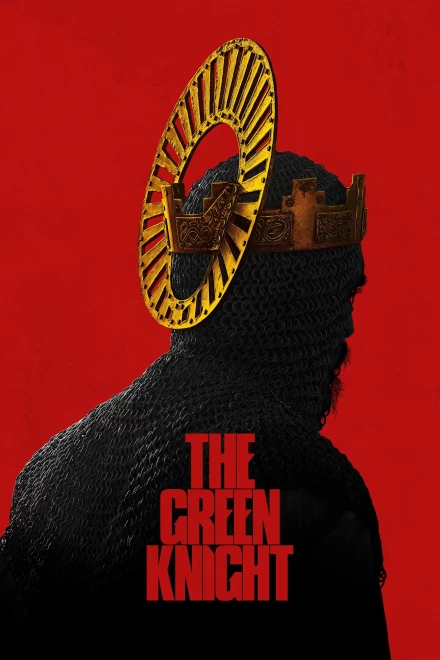
Directed by: David Lowery
Starring: Dev Patel, Alicia Vikander, Joel Edgerton, Ralph Ineson, Sarita Choudhury
🌿 Introduction – A Myth Reborn Through Symbolism
David Lowery’s The Green Knight adapts the medieval poem Sir Gawain and the Green Knight into a cinematic meditation on fear, desire, courage, and the fragile construction of identity. Rather than offering a literal retelling, the film transforms the poem into a dreamlike journey filled with symbolic imagery. The narrative follows Gawain, a young man who longs for greatness but lacks the honor traditionally associated with Arthurian heroes. His journey to confront the Green Knight becomes a study of moral uncertainty and the consequences of self delusion. The film does not attempt to provide direct answers. Instead, it constantly shifts between reality and myth, inviting viewers to consider how stories shape character and destiny.
The Green Knight blends natural imagery, ritual symbolism, and philosophical introspection to explore the internal landscape of Gawain’s fears. The result is a film that uses fantasy not to escape reality, but to illuminate aspects of human experience that are often obscured. Lowery’s visuals feel almost sculpted from folklore and collective memory, creating a world where every shadow holds meaning. Beneath the surface lies a complex critique of masculinity, heroism, and the cultural appetite for legends. The film asks whether individuals pursue honor for the sake of virtue, or merely to avoid being forgotten.
🗡️ The Beheading Game – The Ritual of Honor and Consequence
The opening challenge issued by the Green Knight establishes the symbolic framework for the entire story. The beheading game represents a binding ritual of accountability. Gawain accepts the challenge impulsively, driven by the desire to appear noble before Arthur’s court. Yet his strike against the Green Knight is not an act of heroism. It is a gesture of ego. The Green Knight’s ability to rise and retrieve his own severed head reveals the superficiality of Gawain’s performance. He has won nothing. Instead, he has incurred a debt that he does not yet understand.
This scene introduces the tension between appearance and reality. Gawain seeks the illusion of honor without accepting the discipline required to achieve it. The film uses the beheading game as a metaphor for the commitments individuals make without fully comprehending their implications. It is a warning about the seductive power of identity myths and the dangers of pursuing legacy without moral foundation. The knight’s green coloration, associated with nature, growth, and decay, reinforces the idea that actions carry consequences that become part of the natural order.
🌫️ The Journey Begins – A Pilgrimage of Temptations
Once Gawain leaves Camelot, the landscape becomes a reflection of his psychological state. The forests, fields, and abandoned ruins he travels through are not just settings but symbolic terrains. Each encounter functions as a test designed to expose his flaws. The bandits who ambush him highlight his vulnerability and lack of foresight. Their trickery symbolizes the pitfalls of naivety and misplaced trust. When Gawain is left bound on the ground, the camera rotates slowly, suggesting that his identity is also rotating, uncertain, and fragile.
His meeting with Saint Winifred introduces themes of spiritual responsibility and unresolved trauma. Winifred’s request for Gawain to retrieve her head from the spring echoes the earlier beheading. She represents a form of purity and justice that stands in contrast to Gawain’s self interest. His initial reluctance to help indicates his moral imbalance. When he finally retrieves the head, the act becomes a symbolic rehearsal for the confrontation awaiting him at the Green Chapel. Winifred’s presence suggests that true honor arises not from spectacle, but from compassion and integrity.
🔥 The Fox – A Guide, a Warning, a Voice of Fear
The fox that follows Gawain throughout his journey serves multiple symbolic functions. It represents instinct, caution, and the animal mind that resides beneath human rationality. The fox’s loyalty suggests that Gawain is not entirely abandoned by fate, yet its warnings near the Green Chapel indicate that the path toward honor requires confronting fear rather than avoiding it. When the fox finally speaks, its voice feels like an externalization of Gawain’s own inner anxiety. The fox embodies the protective impulse that often prevents individuals from embracing difficult but necessary challenges.
In folklore, foxes are associated with cunning and transformation. The fox in The Green Knight symbolizes the possibility of moral deviation. If Gawain chooses to listen to the fox and turn back, he avoids physical harm but sacrifices his integrity. The creature’s departure marks the moment when Gawain must rely solely on his own strength. The film uses the fox to highlight the internal battle between comfort and courage.
🏰 The Lord and the Lady – Temptation, Desire, and the Shifting Self
The scenes in the home of the Lord and Lady present the film’s most psychologically complex symbols. The Lord represents generosity, confidence, and a kind of moral straightforwardness. He offers Gawain hospitality but also proposes a pact that mirrors the logic of the beheading game. In contrast, the Lady represents intellect, seduction, and artistic creation. Her interest in Gawain challenges his fragile sense of identity. Her philosophical monologue about the color green introduces the film’s thematic core. She describes green as the shade of growth, rot, envy, rebirth, and inevitability. Her words frame nature as an unstoppable force that consumes all human pretensions.
The Lady’s seduction of Gawain becomes a symbolic test of his discipline. His failure reveals that he has not yet transformed internally. The girdle she gives him, which promises protection, becomes a metaphor for his reliance on external validation rather than inner strength. It also represents the shortcuts people take to escape consequences. When the Lord later kisses Gawain as a playful echo of the pact, the film underscores the instability of social agreements and the blurred boundaries between honesty, desire, and obligation.
🌲 The Green Chapel – Confronting Mortality and the Self
The Green Chapel represents a threshold between life and myth. Covered in moss and shaped like a hollow within the landscape, it symbolizes burial, rebirth, and the slow passage of time. When Gawain kneels before the Green Knight, the ritual echoes religious imagery of confession and penitence. The green of the chapel suggests that Gawain stands within the domain of nature, where human constructs like fame and legacy hold little power.
Gawain’s vision of an alternate life, shown in an extended montage, is one of the film’s most important symbolic sequences. In this fantasy, he survives the encounter, returns home, becomes king, fathers a child, and lives out a reign defined by fear and moral compromise. This imagined life reveals the emptiness of honor gained through avoidance. His rule becomes a slow decay of integrity. The sequence shows that survival without courage leads to a hollow existence. The collapse of his imagined life functions as a symbolic stripping away of illusion.
🧩 Removing the Girdle – The Moment of Truth
When Gawain removes the magical girdle, he rejects the temptation to escape fate. This action symbolizes the transition from false heroism to authentic courage. In that moment, he finally accepts responsibility for his choices. The removal of the girdle is not merely a rejection of magical protection. It represents the shedding of ego, fear, and the desire to control outcomes. Gawain chooses to face death with integrity. This act completes his transformation from a boy seeking admiration to a man capable of moral agency.
The Green Knight’s final words, delivered with a sense of gentle acknowledgment, suggest that Gawain has finally met the standard of honor he once pretended to embody. The phrase spoken at the end, which implies forgiveness or playful acceptance, leaves the conclusion ambiguous. The ambiguity reinforces the idea that honor is not a reward but a continual process of becoming.
🎯 Final Thoughts – A Meditation on Honor, Nature, and Myth
The Green Knight offers a thematic landscape where myth and psychology intertwine. The film challenges viewers to reconsider what it means to pursue greatness. Rather than presenting heroism as an objective state, it depicts it as a fragile negotiation between fear, desire, and responsibility. The recurring imagery of green decay reminds us that nature always reclaims human achievements. Even the tallest legends eventually fall beneath the moss.
At its core, the film argues that honor is not defined by external recognition but by the willingness to confront difficult truths. Gawain’s journey is less about fulfilling a ritual and more about discovering the person he wants to become. His transformation emerges through symbolic encounters that expose the tensions between self image and ethical action. The Green Knight uses the language of folklore to explore the vulnerability inherent in human aspiration. Its symbols evoke both the power and the fragility of trying to live a meaningful life.
 About
About