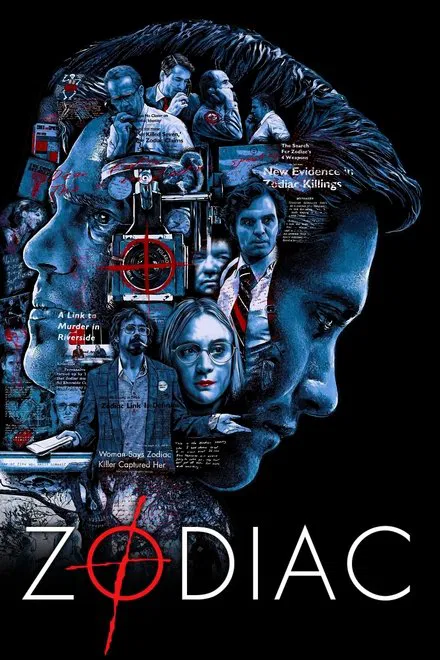
Directed by: David Fincher
Starring: Jake Gyllenhaal, Mark Ruffalo, Robert Downey Jr., Brian Cox, John Carroll Lynch
🕵️ Introduction: Cinema, Journalism, and the Elusive Truth
Zodiac (2007) is not just a crime thriller—it is a meticulous reconstruction of a historical mystery, a meditation on obsession, and a critique of the limits of knowledge itself. David Fincher’s film adapts the real-life story of the Zodiac killer, who terrorized the San Francisco Bay Area in the late 1960s and 1970s. Drawing on Robert Graysmith’s non-fiction books, Fincher crafts a narrative that blurs the line between fact and fiction, challenging viewers to interrogate their own relationship with truth, narrative, and closure.
📰 The Power of Obsession: Graysmith, Toschi, and Avery
The film orbits around three men, each drawn into the Zodiac’s orbit: Robert Graysmith (Jake Gyllenhaal), the cartoonist-turned-investigator; Inspector Dave Toschi (Mark Ruffalo), the weary but dogged cop; and Paul Avery (Robert Downey Jr.), the flamboyant reporter. Their search for answers is as much about their own compulsions as about justice. Graysmith’s transformation from passive observer to obsessed amateur detective serves as the emotional spine of the story.
Fincher’s approach is clinical and precise, eschewing melodrama for procedural rigor. We witness the relentless accumulation of facts—ciphers, witness statements, forensic reports—while the real perpetrator remains forever just out of reach. The film’s obsession with detail mirrors the characters’ own, creating a mood of anxious uncertainty.
⏳ Fact, Fiction, and the Weight of Ambiguity
Zodiac refuses the narrative satisfaction of resolution. The killer is never caught, and the evidence is always incomplete or contradictory. Fincher’s direction leans into this ambiguity, using time jumps, overlapping testimony, and dead ends to emphasize the chaos of real investigation. The effect is both frustrating and haunting—the viewer is left, like the characters, searching for patterns in an ocean of randomness.
The film plays with the audience’s desire for certainty, presenting plausible suspects (most notably Arthur Leigh Allen) only to undermine them with unresolved questions. The absence of a clear answer becomes the central trauma: in the end, the Zodiac’s greatest weapon is not violence, but the power to unsettle, to provoke endless speculation and doubt.
💡 Symbolism: Codes, Shadows, and the City as Character
Symbolism in Zodiac is subtle but pervasive. The Zodiac’s cryptic ciphers are not just plot devices, but metaphors for the unknowable. The repeated imagery of shadows, fog, and labyrinthine streets reflects the psychological and moral ambiguity of the search. San Francisco itself is rendered as a haunted landscape—its beauty and sophistication masking danger, anxiety, and social fragmentation.
The media, too, becomes a symbol—at once a tool for investigation and a source of distortion. Newspaper headlines, televised interviews, and frantic phone calls illustrate the interplay between public spectacle and private terror. In Fincher’s hands, the quest for truth is always mediated, always at risk of manipulation.
🗝️ Endings, Aftermath, and the Persistence of Mystery
The film’s ending is a study in anti-climax: Graysmith’s identification of Allen, Toschi’s resignation, Avery’s decline. None find closure; all are changed, if not broken, by their search. The closing titles offer a bitter coda—Allen dies before he can be definitively connected to the crimes, and the Zodiac case remains open. The lingering question is not “Who did it?” but “Why do we need to know?”
In its refusal to provide easy answers, Zodiac becomes a meditation on the cost of obsession and the impossibility of final truth. The real horror is not the killer in the shadows, but the unending uncertainty that trails in his wake.
🎯 Final Thoughts: The Legacy of Zodiac
Zodiac is a masterpiece of procedural storytelling, but its true power lies in its intellectual and emotional ambiguity. By foregrounding the tension between fact and fiction, knowledge and uncertainty, it holds a mirror to our own hunger for narrative—and our discomfort when the story refuses to resolve. In a culture obsessed with true crime, Fincher’s film remains a cautionary tale: sometimes the only certainty is doubt itself.
 About
About