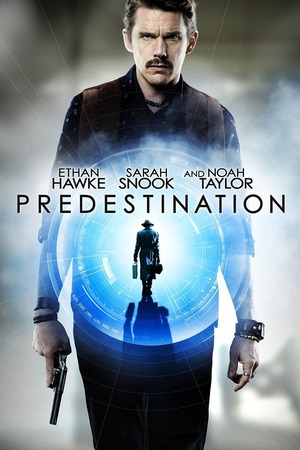
Directed by: Michael and Peter Spierig
Starring: Ethan Hawke, Sarah Snook, Noah Taylor
⏳ Introduction: The Loop That Devours Itself
Predestination (2014) is a philosophical puzzle masquerading as a time travel thriller. Based on Robert A. Heinlein’s short story "—All You Zombies—", it explores a temporal paradox so dense that cause and effect collapse into a closed loop. The film’s narrative, anchored by Ethan Hawke’s mysterious Bartender/Agent and Sarah Snook’s remarkable dual performance, interrogates what it means to have an identity—or fate—when every choice folds back on itself.
🌀 Bootstrap Paradox: The Snake Eats Its Tail
The film’s central enigma is the bootstrap paradox, where an object or person exists with no discernible origin. Jane, born female and later surgically transitioned to male (becoming John), is seduced, impregnated, and abandoned by an older version of herself—eventually giving birth to herself. The Bartender/Agent, an older John, recruits younger John into the time-traveling agency. The story is a Möbius strip: every character, every event, is both cause and consequence.
This narrative loop challenges fundamental ideas of agency, destiny, and selfhood. There is no "first cause" in Predestination; the timeline is self-generating, and every identity is both parent and child. This recursive logic is more than a sci-fi trick—it’s a metaphor for psychological self-creation and the human urge to make sense of origin stories that may be unknowable.
🧬 Gender, Selfhood, and Transformation
Sarah Snook’s portrayal of Jane/John is a tour de force, lending complexity and empathy to a character fractured by biology, circumstance, and time. The journey from orphaned girl to wounded soldier to time-traveling agent is both literal and symbolic—a meditation on gender, alienation, and the longing for belonging. Jane/John is both a victim and author of their fate, repeatedly confronted with versions of the self that are alien yet intimately familiar.
The film’s speculative premise amplifies real-world anxieties about identity: how much of who we are is chosen, and how much is inscribed by time, society, or biology? Predestination refuses to answer, embracing ambiguity as its own form of truth.
🔁 Fate, Free Will, and the Tyranny of the Loop
As the Agent chases the Fizzle Bomber—a terrorist who may be a future version of himself—the film sharpens its inquiry into fate versus free will. Are the characters truly choosing, or are they trapped by a self-fulfilling prophecy? The Bartender’s attempts to avert tragedy paradoxically ensure its fulfillment, echoing the classic time travel motif that knowledge of the future cannot prevent its unfolding.
The final twist—that the Agent and the Fizzle Bomber are the same person, splintered by trauma and repetition—deepens the tragedy. The hero becomes the villain, and the quest to undo suffering only perpetuates it. This is not just a commentary on time travel; it is a reflection on the cycles of trauma and self-destruction that shape lives.
🕰️ Visual Symbolism: Clocks, Mirrors, and Infinity
The film’s aesthetic is steeped in clocks, shadows, and mirrors. The ticking of the time machine, the kaleidoscopic visuals of temporal jumps, and the reflective surfaces in bars and bathrooms—all echo the fractured, looping narrative. The production design (gritty noir interiors, urban alleys, and orphanages) grounds the fantastical premise in a world that feels authentically claustrophobic.
Each jump in time adds layers to the labyrinth, until cause and effect become indistinguishable. Even the music—haunting and cyclical—serves to trap the audience in the same inescapable spiral as the characters.
🎯 Final Thoughts
Predestination is less a story about changing fate and more about the tragedy of being unable to escape it. Its symbolism—snakes, ouroboros, closed doors—reminds us that some mysteries may never be solved, and some identities are built not by choice, but by necessity. The film’s brilliance lies in its refusal to moralize; instead, it presents the paradox of selfhood and time as a riddle, inviting viewers to become lost in its enigma.
 About
About