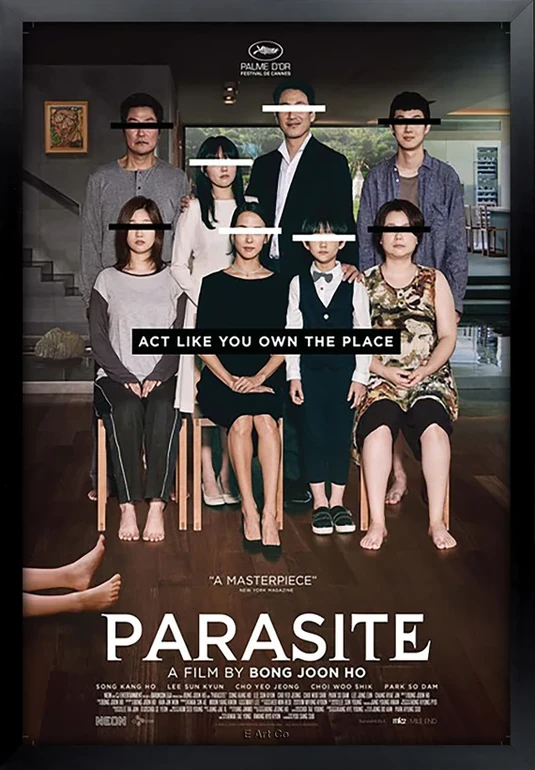
Directed by: Bong Joon-ho
Starring: Song Kang-ho, Lee Sun-kyun, Cho Yeo-jeong, Choi Woo-shik, Park So-dam, Jang Hye-jin, Lee Jung-eun
🧠 Introduction: The Luxury of Illusions, the Reality of Class
Parasite (2019), the first non-English-language film to win Best Picture at the Oscars, is a stunningly layered satire of modern capitalism, family bonds, and the invisible boundaries that shape our lives. Bong Joon-ho’s darkly comedic thriller is packed with symbolism and social critique, but its climax and closing scenes—bloody, surreal, and quietly heartbreaking—have left viewers around the world reeling. What really happens beneath the Park mansion? And what does the ending reveal about hope, mobility, and the cages we build for ourselves?
🏚️ The Descent: Upstairs, Downstairs, and the Hidden Basement
From the outset, Parasite is about infiltration. The Kim family, struggling in a cramped basement apartment, gradually insinuates themselves into the lives of the wealthy Park family, each taking a job as a tutor, housekeeper, driver, or art therapist. Their ruse is equal parts cleverness and desperation—a survival tactic in a world where opportunities are hoarded and passed down like heirlooms. Yet the Parks, ensconced in privilege, remain oblivious to the ways they’re being manipulated—and to the secrets hidden beneath their feet.
The discovery of the mansion’s secret basement, where the former housekeeper’s husband has been hiding for years, turns the film’s upstairs-downstairs metaphor literal. As the story spirals into violence and farce, the Kim family’s hopes for upward mobility are crushed—quite literally—by the weight of systemic inequality and generational trauma.
🔪 The Birthday Massacre: Unraveling Illusions
The film’s climax erupts during Da-song’s birthday party. The basement dweller, Geun-sae, escapes and stabs Ki-jung, while Ki-taek, the Kim family patriarch, kills Mr. Park in a moment of rage and humiliation. This act is not just a crime of passion, but a culmination of years of invisible servitude and casual disrespect. The Parks’ inability to see the suffering beneath their feet—literally and metaphorically—becomes their downfall.
The garden, once a symbol of peace and luxury, becomes a stage for tragedy. In one instant, the illusions of civility and control collapse, exposing the raw violence and desperation simmering below the surface.
🌧️ Flooded Hopes: The Price of Survival
After the massacre, the Kim family’s fortunes sink even further. Their basement home is destroyed in a flood, symbolizing both nature’s indifference and the precarity of their existence. Ki-taek disappears, vanishing into the darkness beneath the mansion, while his son Ki-woo recovers from brain surgery, haunted by guilt and trauma. The Parks, meanwhile, are replaced by another wealthy family, and life at the mansion continues as before—oblivious to the suffering that lingers below.
💭 The Ending: Hope, Fantasy, and the Impossible Dream
The film’s coda is quietly devastating. Ki-woo imagines buying the mansion, freeing his father from the hidden basement, and finally reuniting the family. This fantasy is depicted in warm, glowing images—a utopian vision of upward mobility and redemption. But the camera slowly returns to Ki-woo in his cold, basement apartment, revealing that this future is a dream, as unreachable as the Park family’s world was to the Kims. The message is clear: in a society defined by structural barriers, hope itself can become a trap.
🎯 Final Thoughts: The Parasite That Persists
Parasite ends on a note of bitter ambiguity. Its title refers not only to the Kim family’s “invasion” of the Parks’ world, but to the ways all of us depend on systems, people, and dreams that are ultimately unsustainable. The story’s brilliance lies in its refusal to moralize or offer simple solutions. Instead, it asks us to look—really look—at the invisible lines that divide us, the basements beneath our own feet, and the cost of hope in a world where some doors are always locked from the outside.
 About
About