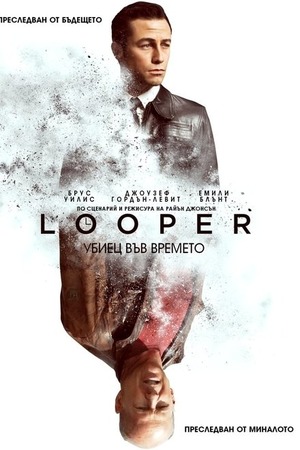
Directed by: Rian Johnson
Starring: Joseph Gordon-Levitt, Bruce Willis, Emily Blunt, Paul Dano, Jeff Daniels
🔫 Introduction: Paradox in a Dystopian World
Looper (2012) spins a violent, stylish web around the familiar mechanics of time travel, but at its core, it is a meditation on choice, destiny, and the ethics of preemptive violence. The story follows Joe (Joseph Gordon-Levitt), an assassin (“looper”) who kills targets sent from the future. His world is upended when his latest victim is his own older self (Bruce Willis), leading to a tense cat-and-mouse game that is as much about self-destruction as it is about survival.
🕰️ The Loop as Metaphor for Addiction and Escape
Loopers are hired killers who know their contracts will end with their own deaths (“closing the loop”). This existential arrangement becomes a metaphor for self-destruction and denial. Joe spends his pay on drugs, parties, and fleeting pleasures, all the while ignoring the inevitability of his fate. The system promises short-term gain, but the price is ultimate annihilation. The loop, then, is not just temporal, but psychological: a cycle of violence and consequence from which escape seems impossible.
🌾 Violence, Poverty, and the Future
Looper’s world is one of decay—Kansas cornfields stretch into the horizon, cities crumble, and poverty is endemic. Johnson grounds his sci-fi premise in a plausible dystopia where technology and crime are tightly intertwined. The act of sending bodies from the future to be disposed of in the past dramatizes society’s impulse to bury its problems rather than solve them. This is time travel as a metaphor for repression, and the consequences, like the bodies, eventually resurface.
👦 The Child and the Breaking of the Cycle
The heart of the film lies in Joe’s relationship with Cid, a telekinetic child destined to become the feared Rainmaker. Old Joe (Bruce Willis) returns not to save himself, but to kill Cid before he can grow into a tyrant. Young Joe, however, glimpses a path to redemption—by sacrificing himself, he can prevent the violence from ever beginning. The final act is a profound reversal: instead of repeating the loop, Joe chooses to break it, accepting his own death to save others from suffering.
This choice elevates Looper above standard time travel fare, positioning free will as a genuine, if costly, possibility. The film contends that destiny is not inevitable, and cycles of trauma can be interrupted by conscious sacrifice.
🔄 Mirrors and Doubling: The Self in Conflict
The visual motif of mirrors, twins, and doubles runs throughout the film. Joe is both the agent and the victim of violence; his future and past selves are locked in a battle for control. Their encounters are not just literal shootouts, but symbolic confrontations with regret, desire, and the fear of becoming one’s worst self. This doubling asks the audience to reflect on the potential for change—are we bound by our pasts, or can we choose a different path?
🎯 Final Thoughts
Looper stands as a parable of violence and consequence in a world where time is commodified and morality is negotiable. Its cyclical structure, noir atmosphere, and character-driven paradoxes offer no easy answers, only the hope that through self-awareness and courage, one might escape the tyranny of repetition. The film’s final shot—a sunlit field after sacrifice—serves as both elegy and promise: the loop is broken, if only for a moment.
 About
About