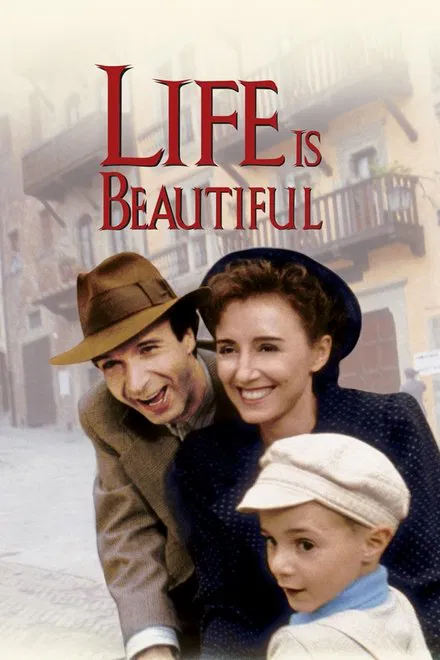
Directed by: Roberto Benigni
Starring: Roberto Benigni, Nicoletta Braschi, Giorgio Cantarini, Giustino Durano, Sergio Bini Bustric
🧠 Introduction: A Fairy Tale in the Shadow of Horror
Life Is Beautiful (1997), or La vita è bella, is a film that dares to find light in humanity’s darkest hours. Roberto Benigni’s deeply moving story of Guido, a Jewish Italian father who uses humor and imagination to shield his son from the horrors of a Nazi concentration camp, is as controversial as it is beloved. The film’s bittersweet ending—at once tragic and redemptive—has stirred debate ever since its release. What does Guido’s sacrifice mean? How does the story’s blend of comedy and tragedy work, and what endures in the heart of a child?
🎭 The Game of Survival
The first half of Life Is Beautiful is a romantic comedy: Guido’s whimsical pursuit of Dora, his poetic wordplay, and a life filled with laughter. The story darkens after Guido and his son Giosuè are interned in a concentration camp. Determined to protect his son’s innocence, Guido invents a fantastical “game,” telling Giosuè that the camp’s deprivations are all part of an elaborate contest. Each day becomes a challenge to earn “points,” and every hardship is reframed as an adventure. Dora, meanwhile, has volunteered for transport, separated from her family and clinging to hope through stolen glimpses and messages.
🪖 Sacrifice and the Power of Story
As the war nears its end and the camp is thrown into chaos, Guido’s deceptions become ever more desperate. In the film’s devastating climax, he is caught and executed while searching for Dora. But even as he is marched to his death, Guido keeps up the pretense for his son, miming a silly walk and flashing a final smile. Giosuè survives, believing he has won the game, and is finally reunited with his mother.
💔 Ending Explained: What Remains
The power of Life Is Beautiful is that its ending is both crushing and uplifting. Guido’s death is a tragedy, but the innocence he preserves for Giosuè is a kind of victory. The film’s final narration—spoken by Giosuè as an adult—reminds us that his father’s sacrifice and love gave him the gift of life, and that this memory is his true prize. In a world broken by hatred, hope survives through acts of kindness, courage, and imagination.
🎯 Final Thoughts: Love’s Enduring Game
Life Is Beautiful affirms that storytelling itself can be an act of resistance, a way to defy evil by refusing to surrender the heart. Its ending is a testament to the power of love, not as sentiment, but as a force that endures beyond suffering, and gives meaning to survival. For audiences, the “game” is a lens through which we see the possibility of joy, even when all seems lost.
 About
About