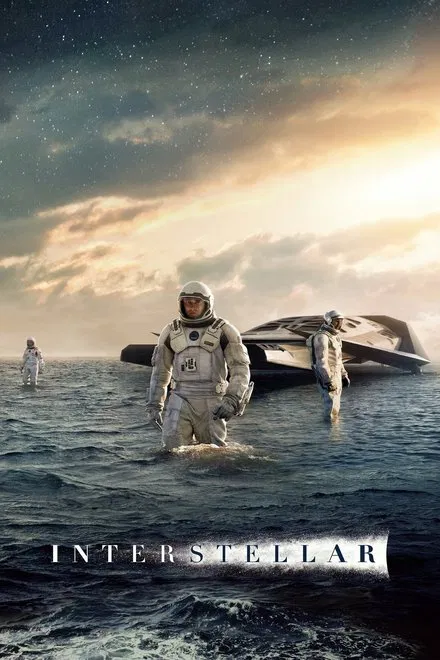
Directed by: Christopher Nolan
Starring: Matthew McConaughey, Anne Hathaway, Jessica Chastain, Mackenzie Foy, Michael Caine
🧠 Introduction: Across Time and Stars
Interstellar (2014) is Christopher Nolan’s grandest vision—a cosmic odyssey through black holes, quantum paradoxes, and the enduring power of human connection. Its ending, filled with mind-bending science and raw emotion, has left audiences marveling and debating ever since. What really happens inside the tesseract? How does love serve as a bridge between dimensions? Does Cooper return to the “real” world, and what does the film say about fate and free will?
🌎 The Fate of Earth: Desperation and Departure
Earth is dying. Crops fail as blight and dust storms ravage the planet, driving humanity to the edge of extinction. Cooper (Matthew McConaughey), a former pilot and engineer, is recruited by NASA to find a new home for humanity through a wormhole near Saturn. The mission is a leap of faith: scientists hope that traversing the wormhole will reveal habitable worlds in another galaxy. Cooper leaves his daughter Murph (Mackenzie Foy, later Jessica Chastain) behind, haunted by the fear that he may never see her again.
🌀 The Wormhole and Relativity: Time as an Enemy
Cooper, Brand (Anne Hathaway), and their crew travel through the wormhole, visiting alien worlds where the laws of physics bend. On Miller’s planet, time dilates—one hour equals seven years on Earth. This relentless relativistic effect becomes a source of agony: every decision costs Cooper precious time with his children, who age decades while he remains the same.
Murph grows up embittered by her father’s absence, while Cooper battles guilt and cosmic uncertainty. The passage of time is rendered not as an abstract concept, but as a wrenching emotional reality, dividing loved ones and raising the stakes for every choice.
🌌 The Tesseract: Love Across Dimensions
The film’s climax occurs inside a black hole, Gargantua, where Cooper ejects himself to allow Brand to escape. Instead of being crushed, Cooper finds himself inside a tesseract—a hypercube where time is represented as a physical dimension. He can see every moment of Murph’s childhood, reaching through gravity to communicate with her across time.
Using Morse code, Cooper transmits quantum data needed to solve the gravity equation that will save humanity. The tesseract, constructed by “future humans” or fifth-dimensional beings, is a visualization of love as a force that transcends spacetime. The film’s thesis—echoed by Brand’s earlier monologue—is that love, like gravity, is a real and quantifiable link between people, even when separated by the vastest gulfs.
⏳ Return and Reunion: Hope Beyond the Event Horizon
After sending the data, Cooper is expelled from the tesseract and awakens near Saturn, rescued by the space colony Cooper Station. Decades have passed on Earth, but his daughter Murph, now a revered scientist, is still alive—elderly and near death. Their reunion is brief and deeply moving: Murph urges Cooper to seek Brand, who is establishing a new human home on Edmunds’s planet. The cycle of parent and child, departure and return, is completed, not with closure but with acceptance and hope.
🎯 Ending Explained: The Human Heart’s Gravity
Interstellar ends as a celebration of science and feeling, intellect and faith. The tesseract sequence is not simply a visual spectacle, but a metaphor for the complexity of love and the enduring hope that binds generations. Cooper’s journey is both cosmic and intimate, and Nolan’s message is clear: our capacity for wonder, sacrifice, and connection is what ensures our survival. The universe is vast, but meaning is found in the bonds we refuse to break, even as time itself conspires against us.
 About
About