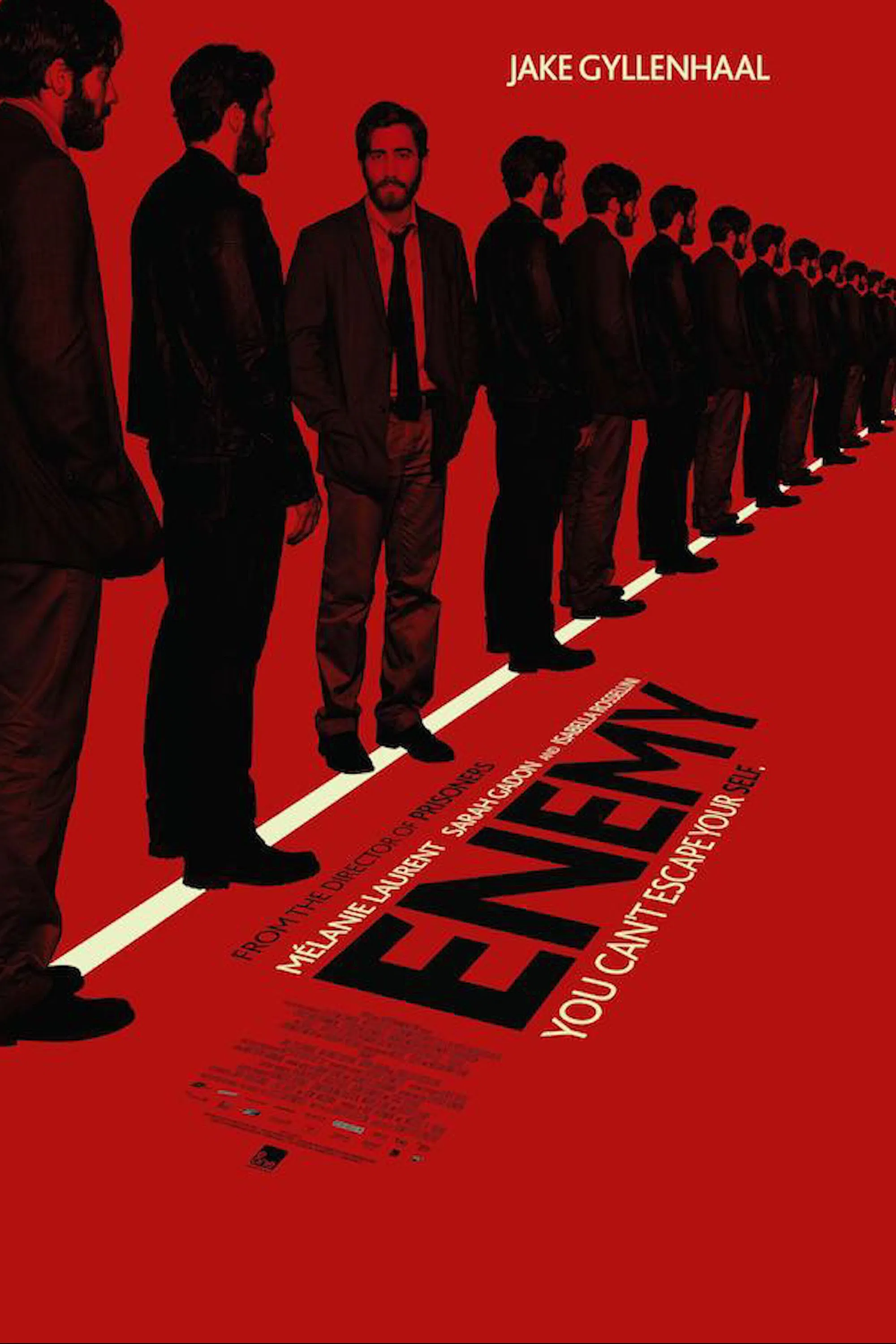
Directed by: Denis Villeneuve
Starring: Jake Gyllenhaal, Mélanie Laurent, Sarah Gadon, Isabella Rossellini
🧠 Introduction: A Tale of Two Selves
Enemy (2013), adapted from José Saramago’s novel The Double, is one of Denis Villeneuve’s most cryptic and visually arresting films. Its haunting atmosphere and dense symbolism have left audiences puzzling over its enigmatic ending for years. The film follows Adam Bell (Jake Gyllenhaal), a history professor in Toronto, whose life unravels after he discovers his exact double, Anthony. What begins as a curiosity soon devolves into obsession and terror—culminating in one of cinema’s most unforgettable final shots: a monstrous spider lurking in a bedroom corner. What does it all mean? Let’s unravel the web.
🔄 The Plot: Duality and Dissociation
Adam lives a monotonous existence—until, on a colleague’s recommendation, he rents a film and notices an actor who looks identical to him. Adam seeks out his double, Anthony, who is more confident, aggressive, and entangled in risky behavior. Their lives become dangerously intertwined, blurring the boundaries between reality, fantasy, and identity.
The doppelgänger motif is central: Villeneuve’s visual language (mirrors, reflections, yellow filters) constantly reminds viewers that Adam and Anthony may be two halves of one psyche. The city itself becomes a maze, with recurring motifs of power, control, and entrapment. The mysterious presence of spiders—sometimes subtle, sometimes shockingly literal—further complicates the narrative.
🕷️ Spiders as Symbol: Control and Fear
Spiders appear in dream sequences, mural art, and most chillingly, in the film’s closing moments. Many critics interpret the spider as a representation of women, sexual repression, or the web of lies Adam weaves around himself. The repeated imagery—a naked woman with a spider’s head, a giant arachnid striding across Toronto—serves as a visual metaphor for Adam’s anxieties and the suffocating aspects of his relationships.
Director Denis Villeneuve has hinted that the spider embodies the theme of control: Adam feels trapped by his commitments and desires, haunted by guilt, and forever caught in the tension between stability and risk. The final spider in the bedroom signals Adam’s realization that he can never truly escape these forces—they are an inescapable part of himself.
🔄 The Ending: Who Survives?
The final act is deliberately ambiguous. After a series of betrayals and role reversals, Anthony (posing as Adam) dies in a car crash with Adam’s girlfriend, while Adam prepares to return to his routine life. The film’s final moments—a gigantic spider cowering in fear—suggest that Adam, despite surviving, remains ensnared by his subconscious fears. Is the spider real, or a manifestation of his psyche? Is Adam now fully “Anthony,” doomed to repeat his mistakes?
🎯 Final Thoughts: The Endless Loop
Enemy resists easy answers. Its cryptic storytelling and rich visual symbolism invite endless debate. The ending can be seen as a warning: until we confront our inner fears and contradictions, we are doomed to repeat our cycles of self-destruction—always haunted by the shadows in our own minds.
 About
About