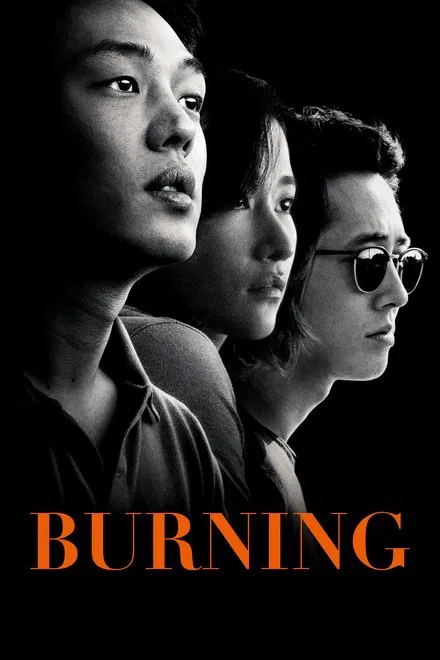
Directed by: Lee Chang-dong
Starring: Yoo Ah-in, Steven Yeun, Jeon Jong-seo
🧠 Introduction: What Really Burns?
Burning (2018), adapted from Haruki Murakami’s short story “Barn Burning,” is a hypnotic and unsettling meditation on obsession, longing, and social invisibility. The film’s central mystery—what happened to the enigmatic Hae-mi?—is left unresolved, and its final, shocking act has sparked endless debate. What does Jong-su really discover? Who—or what—is burning?
🔥 The Triangle: Desire and Power
Jong-su, a drifting young writer, falls for childhood acquaintance Hae-mi, only to see her swept away by the charming, wealthy Ben. The trio’s dynamic is quietly suffocating: Ben’s inscrutable calm, Hae-mi’s volatility, and Jong-su’s festering resentment. Ben hints at a secret pastime—burning abandoned greenhouses—a metaphor for the destruction of the marginalized and unseen. Hae-mi’s sudden disappearance intensifies Jong-su’s obsession and sense of impotence.
🌫️ The Ending: Violence, Catharsis, and the Unanswered
In the film’s ambiguous climax, Jong-su kills Ben and sets his car on fire, standing naked in the snow as the flames rage. Is this justice, madness, or a desperate bid to be seen in a world that ignores suffering? The fate of Hae-mi is never revealed. Was Ben a serial killer, or simply a symbol of unreachable privilege? Has Jong-su avenged a crime, or committed one in vain?
🕯️ The Invisible Fire
The film’s title is a metaphor for desire, frustration, and the violence lurking beneath everyday life. Like the greenhouses Ben burns, the poor and vulnerable vanish without notice, their pain erased by those in power. Jong-su’s act is both a literal and figurative explosion, an assertion of agency in a world of silence.
🎯 Final Thoughts: The Mystery That Remains
Burning ends not with answers, but with haunting questions. In a society where justice is elusive and truth is obscured by privilege, the “fire” that consumes us may be invisible—yet its heat and devastation are all too real.
 About
About